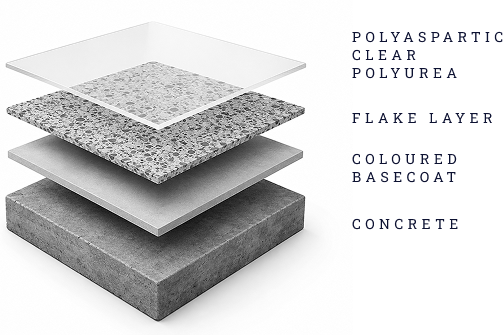
With no grout lines or seams for dirt, bacteria, or moisture to collect in, polyaspartic flooring is easy to sweep, mop, and maintain, whether that’s a food processing facility that needs to meet hygiene standards or a family garage that just needs to stay presentable. Less maintenance, less hassle, and a floor that holds up to regular cleaning without dulling over time.
Handles Oils, Chemicals and Spills
Garages see motor oil and brake fluid. Warehouses and plants see solvents, cleaning agents, and the occasional forklift leak. Polyaspartic coatings are built to resist all of it. That’s one of the reasons polyaspartic has become the go-to over standard epoxy in spaces where chemical exposure is part of daily life, from industrial facilities to everyday garage floors.
Built for Heavy Traffic
Whether it’s forklifts moving pallets all day or your car rolling in and out of the garage every morning, polyaspartic flake flooring is made to not show it. The flake system adds an extra layer of strength on top of the base coat, so the surface resists scratches, dents, and wear far longer than paint or standard epoxy.
How we install?
01
Prep
Patch any existing cracks all around the floor
02
Base Coat
Epoxy body applied
03
Flake / Color
Broadcast & finish selected
04
Topcoat & Cure
Sealed & cured for use
Flake Colours
Every space is different, and the finish should match the job. Below are some of our most requested polyaspartic flake blends, from clean neutrals that work in showrooms and offices to darker, high-hide colours that hold up better in garages.
Domino
Coyote
Night Fall
Autumn
Frequently Asked Questions
Straight answers to what GCs, facility managers and homeowners ask us most
With proper installation, a polyaspartic or epoxy floor can easily last 10-20 years, even in high-traffic commercial spaces. Garages and light-use areas tend to see the longer end of that range. The differentiating factor has been the surface prep. Most “epoxy failures” people hear about actually come down to a rushed or skipped concrete prep step, not the coating itself. That’s why we grind and properly prep every floor before anything goes down.
How much does commercial epoxy flooring cost?
It really depends on the size of the space, the condition of the existing concrete, and the system you go with. A basic coating costs less than a full flake or polyaspartic system. Rather than throw out a number that won’t apply to your space, we usually walk the site (or review drawings) and give you an itemized quote so you know exactly what you’re paying for and why. Send us your drawings or details and we’ll get you a quote right away.
How long is my facility out of service during install?
This is usually the biggest question for commercial and industrial clients.. Traditional epoxy can take several days to cure fully. One of the reasons we like polyaspartic systems is speed. They cure much faster, often allowing light foot traffic within 24 hours. We’ll always give you a realistic timeline upfront and can plan installs around off-hours or weekends to minimize disruption to your operations.
Is epoxy slip resistant?
On its own, a smooth glossy epoxy finish can actually get slippery when wet. It is something a lot of people don’t realize until it’s a problem. That’s why we recommend adding a slip-resistant additive to the topcoat, especially in areas with foot traffic, moisture, or oil exposure, like kitchens, washrooms, or industrial floors. It’s a small addition that makes a real difference in day-to-day safety, and we can advise on the right level of texture based on how the space is used.